Sixth Men
Last and First MenThe Sixth Men were a terrestrial offshoot of the Fifth species on Venus, reduced in stature and brain and isolated for millions of years in a restricted island environment. Their long stagnation ended when geological upheaval created new land and renewed social conflict, making them the starting point for a more versatile human society. Across their history, fascination with flight repeatedly shaped their religious imagination.
Identity and Origins
The Sixth Men emerged from a branch of the degenerated Fifth species that retained a terrestrial way of life and the ancient human form. Their diminished size and brain marked them as so unlike the original settlers that the narrative treats them as a distinct species, rather than simply as a weakened remnant of their predecessors.
Their setting was a Venus already prepared for human settlement. Vegetation bred for the planet had spread across islands and formed immense floating masses in the ocean, while the land could support only a fraction of Earth’s population. The Sixth Men’s history unfolded within that constrained world, among island habitats and a marine ecosystem increasingly populated by descendants of terrestrial life.
Survival and Stagnation
For age after age, the Sixth Men made a precarious living from the forested islands. They grubbed for roots, trapped abundant birds, and caught fish in tidal inlets with ground bait. Their lives were closely entangled with those of their seal-like relatives: the two branches sometimes ate one another, a stark reminder that the boundaries between human descendants and other adapted forms on Venus were not secure.
The Sixth Men’s environment changed little, and for millions of years their biology and culture remained correspondingly stagnant. Their subsistence depended on the local abundance of plants, birds, and fish, but their limited and constant surroundings offered little impetus for broader development. The account presents their long persistence not as progress toward a predetermined civilization, but as an extended interval in which both society and species changed very little.
Geological Change and Renewal
That condition ended when a major warping of Venus’s crust produced an island almost as large as Australia. As the new land became populated, clashes among its tribes helped bring forth a more versatile race. Methodical agriculture and craftsmanship returned, along with complex social organization and intellectual exploration.
The island’s emergence thus altered more than the geography available to the population: it opened a new phase of human development. The Sixth Men’s prolonged stagnation gave way to social and cultural renewal through settlement and conflict, after which Venus repeatedly experienced forms of civilization comparable to those once seen on Earth, though with characteristic differences.
Flight and Religious Imagination
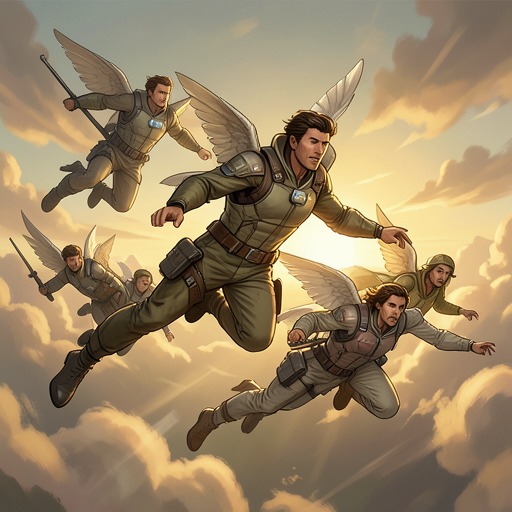
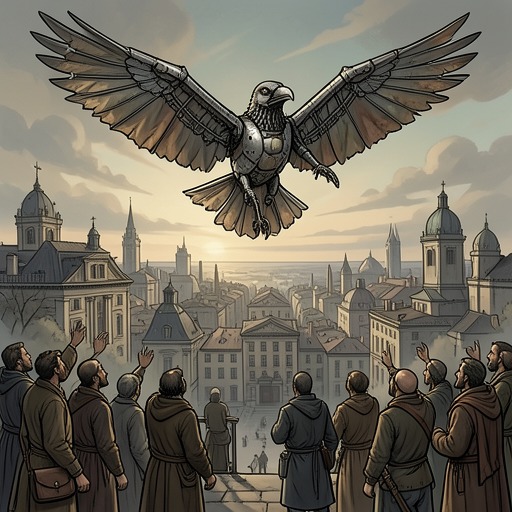
The Sixth Men were repeatedly fascinated by flight, and the bird became one of their most sacred symbols. Their monotheistic traditions could imagine divinity as a powerful sea-eagle, a merciful giant swift, or a disembodied spirit of the air. In one version, a bird-god became human in order to give humanity flight in both a physical and spiritual sense.
These recurring images make flight more than a practical aspiration in the Sixth Men’s history: it also became a way to conceive divine power and human transformation. Their bird-centered religious imagination belongs to a broader cycle of cultural change on Venus, where beliefs and social orders repeatedly arose, shifted, and disappeared. The Sixth Men’s own long stagnation and renewal form one distinct passage within that much larger repetition.